

Search is evolving. The challenge is no longer just getting discovered, but making your
expertise easy to find, understand and trust.
B2B buyers are discovering information in different ways. They may search Google for a
solution, look for a direct answer to a specific question or use an AI tool to compare options.
For marketers, this raises an important question: Is being visible in search results enough, or
does content also need to serve direct answers and AI-driven discovery?
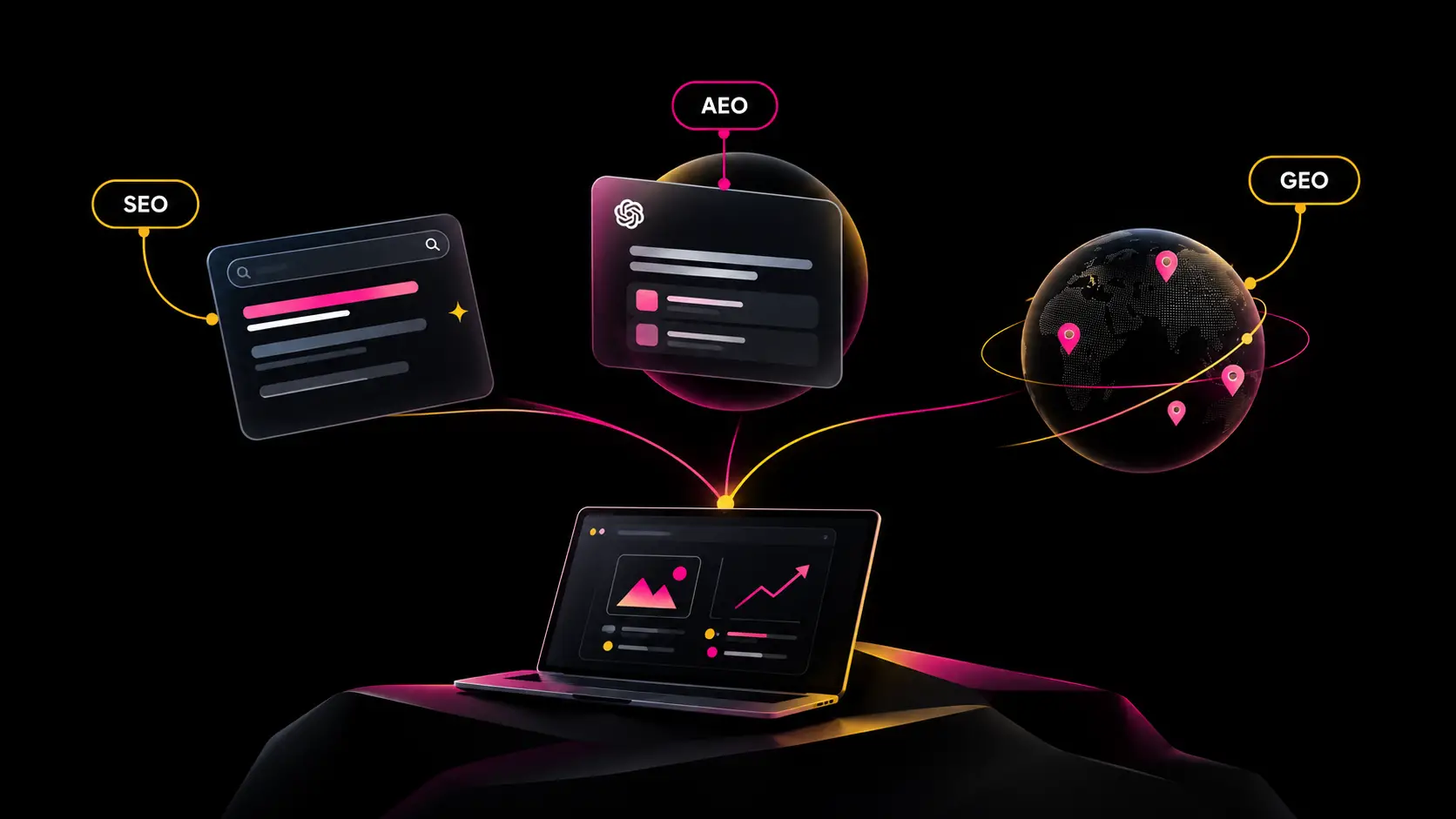
This is where three approaches become relevant: Search Engine Optimisation (SEO),
Answer Engine Optimisation (AEO) and Generative Engine Optimisation (GEO).
But understanding what these terms mean is only the starting point.
The more important question is: How should they change the way B2B companies
create, structure and measure their content?
1. Three approaches, three different discovery needs
SEO, AEO and GEO overlap, but each puts the emphasis on a different part of the discovery
experience.
SEO: Help the right audience find you
Search Engine Optimisation focuses on making relevant website content discoverable
through search engines.
For example, a SaaS company targeting growing businesses might create a page around
“CRM software for SaaS companies.” The page should address the buyer’s needs, explain
the solution clearly and provide useful information.
The focus: Search intent, relevant pages, website structure and useful content.
The marketing question is: Are we creating the right content for what our audience is
actively searching for?
AEO: Help your content answer the question
Answer Engine Optimisation focuses on making content useful for answering specific
questions.
A buyer researching CRM software might ask, “What features should a SaaS CRM include?”
Clear explanations, descriptive headings and relevant FAQs can help address these
questions directly.
The focus: Direct answers, clear explanations and buyer questions.
The marketing question is: Does our content address the questions buyers actually
need answered?
GEO: Make your expertise easier to understand and evaluate
Generative Engine Optimisation focuses on how a brand’s information and expertise may
appear in AI-generated responses.
For instance, a buyer might ask an AI tool to compare CRM platforms. Clear information,
original insights, substantiated claims and credible references can help communicate a
company’s expertise.
GEO does not guarantee that a brand will be mentioned or recommended by AI tools.
The focus: Original perspectives, credible evidence and clear brand information.
The marketing question is: Are we publishing clear, credible information that could help AI systems and buyers understand our expertise?
2. How the three approaches work together
The mistake is to treat SEO, AEO and GEO as three completely separate content strategies.
Imagine a buyer researching CRM platforms.
- SEO: They discover a relevant resource through search.
- AEO: They find clear answers to questions about features and requirements.
- GEO: They may encounter brand information in an AI-generated comparison.
These experiences can overlap. A single, well-developed resource can support all three by
addressing search intent, answering buyer questions and demonstrating expertise.
The goal is not to create three versions of every piece of content. It is to create useful
content that serves different discovery experiences.
3. What should change in your B2B content strategy?
Understanding the terminology is useful. Translating it into marketing decisions is where the
real work begins. Here are four areas B2B marketers should examine.
A. Move from keyword-led content to buyer-question-led content
Understand what buyers are trying to learn or decide. Create content that addresses their
questions at different stages, from initial research to evaluating solutions.
Before creating a resource, ask:
- What is the buyer trying to understand or decide?
- What information do they already have?
- What questions are still unanswered?
- What would help them evaluate their options?
This gives content a clear purpose beyond targeting a search term.
B. Make answers clear, but keep the necessary depth
Answer-ready content does not have to be superficial.
B2B decisions can involve multiple stakeholders, technical considerations, financial
implications and longer evaluation cycles. A short answer may introduce the topic, but it may
not provide enough information to support a decision.
For example, a guide to choosing a CRM for a SaaS company could explain the essential
evaluation criteria, why they matter, how requirements differ by business stage and which
trade-offs buyers should consider.
Clear headings and logical sections make the resource easier to navigate without sacrificing
depth.
C. Build authority through original thinking, not content volume
Publishing more content does not automatically make a brand more credible.
When multiple companies cover the same topics with similar explanations, another generic
article may add little value.
That could be a practical framework, an original point of view, an explanation of a common
mistake, a relevant example or evidence that challenges an accepted assumption.
For B2B companies, this is especially important because buyers are not simply collecting
information. They are evaluating which businesses understand their challenges and can
offer a credible perspective.
The objective should be to publish something useful and distinctive—not to produce more
content for its own sake.
D. Connect visibility to business outcomes
SEO provides familiar measures such as impressions, clicks, rankings and conversions. For
AEO and GEO, marketers may also want to monitor answer appearances, citations, brand
mentions and AI referral traffic where reliable measurement is available.
A brand mention does not automatically mean a qualified lead. A search click does not
automatically mean buying intent. And visibility does not necessarily translate into revenue.
The useful questions are:
- Are we reaching the audience we want to reach?
- Are relevant people engaging with our content?
- Are our resources supporting evaluation and consideration?
- Can we connect these interactions to enquiries, opportunities or conversions?
The aim is to understand whether the content is contributing to the buyer journey—not
simply whether it is visible.
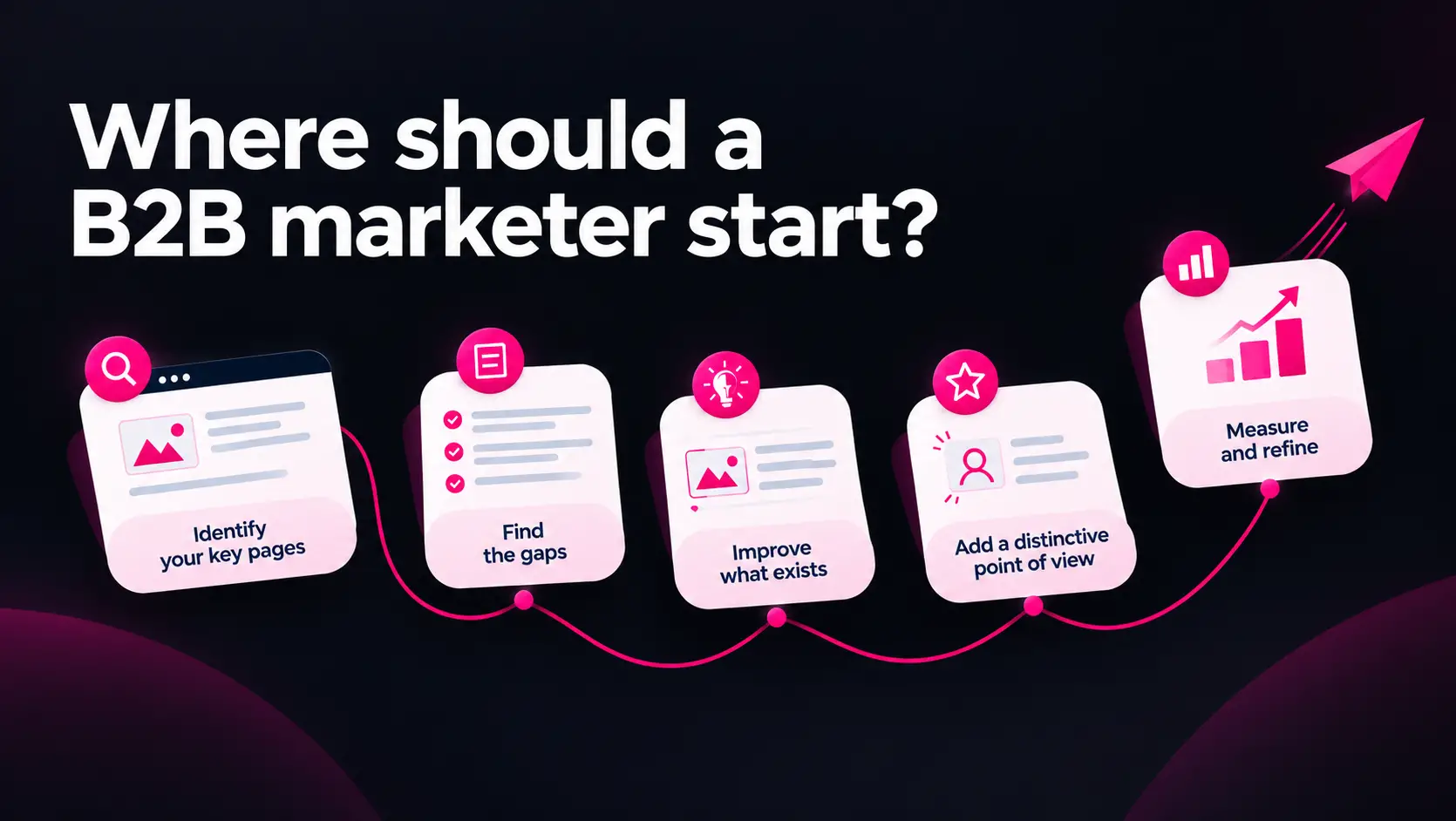
4. Where should a B2B marketer start?
Rather than rebuilding everything, begin with your existing website and content.
Step 1: Identify your most important pages.
Begin with your main service pages, core solution pages and resources that support your
target audience’s key questions.
Step 2: Find the gaps.
Check whether these pages match buyer intent, answer relevant questions, explain your
offering clearly and provide sufficient evidence to support their claims.
Step 3: Improve what exists before creating more.
Strengthen unclear explanations, add missing context, improve navigation and make the
content more useful to the intended reader.
Step 4: Add a distinctive point of view.
Identify where your team’s experience can contribute original thinking, practical frameworks
or insights that go beyond generic advice.
Step 5: Measure and refine.
Monitor the visibility signals available to you, but evaluate them alongside engagement,
enquiries and other meaningful business outcomes.
This creates a more manageable starting point than launching separate initiatives for SEO,
AEO and GEO without a shared direction.
Build a connected strategy.
SEO helps relevant content become discoverable through search. AEO focuses on
answering specific information needs. GEO considers how a brand’s content and expertise
may be represented in generative AI experiences.
Each has a different emphasis, but all three benefit from the same fundamentals: useful
content, clear messaging, accessible information and credible expertise.
For B2B marketers, the opportunity is to move beyond optimising individual pages in
isolation and think about the role content plays in helping buyers discover, understand and
evaluate a business.
The question is no longer just whether your website can attract attention.
It is whether the information you publish helps the right audience understand the problem,
make sense of its options and recognise the value of your expertise.
Be discoverable. Be useful. Be credible.
That is the foundation of a connected B2B discovery strategy.