


When messaging isn’t converting, most teams don’t recognise it as a messaging problem. There’s content going out, engagement to point to, and enough activity to suggest the fundamentals are in place.
What’s often missing is clarity. Content output is mistaken for messaging effectiveness, and steady activity masks a narrative that isn’t strong enough to move buyers forward. The message exists but it isn’t doing enough work.
This is where scaling becomes risky. Without a clear narrative underneath, increasing reach doesn’t improve outcomes; it amplifies confusion. Before pushing execution further, teams need to be sure the message itself is carrying the conversation.
Where messaging breaks first
Messaging failures rarely show up as a single breakdown. They surface gradually, across touchpoints where buyers are trying to make sense of the story.
One of the earliest and clearest signals appears in sales conversations. In client conversations, the message either creates clarity or introduces friction. Prospects ask orienting questions instead of advancing the conversation. They struggle to place the product, misunderstand who it’s for, or fixate on the wrong value. These aren’t objections, they’re signals that the buying context hasn’t been framed clearly enough.
The same gaps appear earlier in the journey, often more quietly. On the website, buyers read multiple pages but still leave without a clear understanding of relevance. In inbound conversations, leads arrive interested but poorly qualified, forcing teams to re-explain fundamentals. In content, engagement exists but doesn’t translate into next steps, because the message informs without directing.
Internally, messaging breaks during handoffs. Marketing, sales, and leadership describe the value in slightly different ways. Decks evolve independently. Language shifts depending on who’s telling the story. Each piece makes sense in isolation, but together they create inconsistency.
Across all these moments, the signal is the same. If a message can’t move a buyer forward without explanation, reinforcement, or reinterpretation, it isn’t ready to be amplified. Scale doesn’t fix that, it exposes it.
Why most B2B messaging fails
When messaging starts to break down in conversations, the underlying causes are usually consistent. They’re not about effort or creativity. They’re about how the message was formed.
- Messaging is built without a clear buying trigger: Many messages explain what a product does but never anchor why it matters now. Without a trigger, new risk, missed opportunity, changing priorities messaging feels informational rather than urgent. Buyers understand it, but don’t act on it.
- ICPs are defined too broadly to be useful: Messaging that tries to appeal to everyone ends up resonating deeply with no one. Broad ICPs force generic narratives that avoid specificity. In sales, this shows up as constant requalification and repositioning.
- One narrative is forced across all stages: Early curiosity and late-stage evaluation require different framing. When the same message is used everywhere, it feels either too vague or too detailed. Sales ends up reframing mid-conversation to bridge the gap.
- Value is framed around features, not trade-offs: Messaging that lists capabilities without clarifying trade-offs leaves buyers to do the comparison work themselves. Without a clear stance, differentiation becomes fuzzy and decisions slow down.
- Messaging is validated internally, not externally: Internal alignment is mistaken for readiness. Messaging sounds right in decks and workshops, but until it’s pressure-tested in real conversations, it remains unproven.
- Messaging lives in marketing, not across the GTM motion: When messaging isn’t naturally used by sales, founders, and customer-facing teams, it fragments across touchpoints. Buyers experience this as inconsistency, even if each asset looks polished.
The common thread is structural. Messaging is treated as a communication task instead of a go-to-market decision.
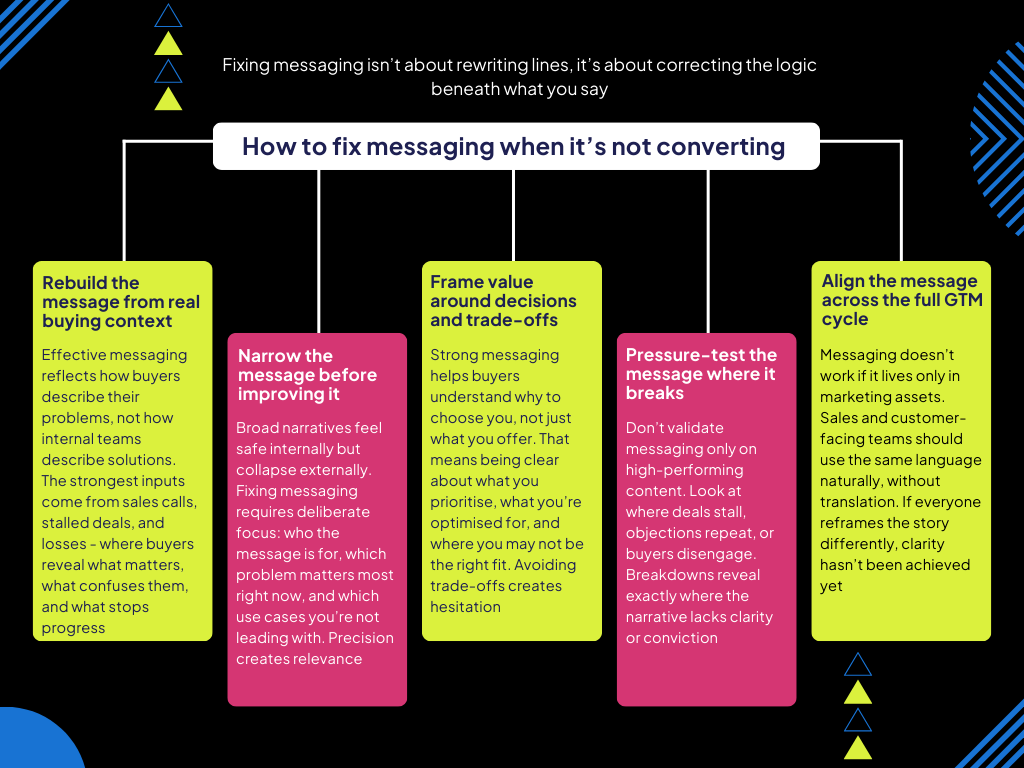
Fixing messaging takes more effort than refreshing content, but it removes friction everywhere else. Once the narrative is clear, execution becomes easier and conversations move faster.
How to know your messaging is ready to scale
Messaging readiness shows up in behaviour, not confidence.
Sales teams start using the language without prompting. Conversations begin at the right altitude, with buyers referencing the problem as you framed it. Objections become more specific, not more generic. The message holds across formats; content, decks, and conversations – without losing meaning.
Most importantly, conversion improves before additional spend is introduced. Messaging that’s ready doesn’t need amplification to prove itself. Scale simply extends what’s already working.
When these signals are present, scaling is a logical next step. When they’re not, scaling is guesswork.
Conclusion: fix the message before you amplify it
When messaging doesn’t convert, the instinct is to push harder. More content. More reach. More activity. But scale doesn’t create clarity – it exposes the lack of it.
The teams that make progress pause long enough to understand where their message breaks, why it breaks, and what needs to change before it’s amplified. They treat messaging as a GTM decision, not a content exercise. Before making your message louder, make it clearer. That’s what allows everything else to scale with confidence.